
Understanding the Connection Between Your Jaw and Your Head Pain
By Berdene Segal
BSc Physiotherapy (Wits) | Advanced Master’s Degree in Integrative Medicine Craniosacral Therapy Practitioner (Upledger Institute®)
Be Better Health and Wellness
If you’ve ever woken up with a dull, persistent headache that seems to radiate from your temples or wrap around your skull like a tight band, you may have wondered whether something more than stress is at play. And if you’ve also noticed a clicking jaw, tension along your jawline, or jaw pain when chewing, there’s a good chance your headaches and jaw symptoms are more connected than you realise
You’re not alone in asking, “Why does my jaw hurt?”—and more importantly, why does it seem to trigger headaches that disrupt your daily life?
The Hidden Link: How Your Jaw Can Cause Headaches
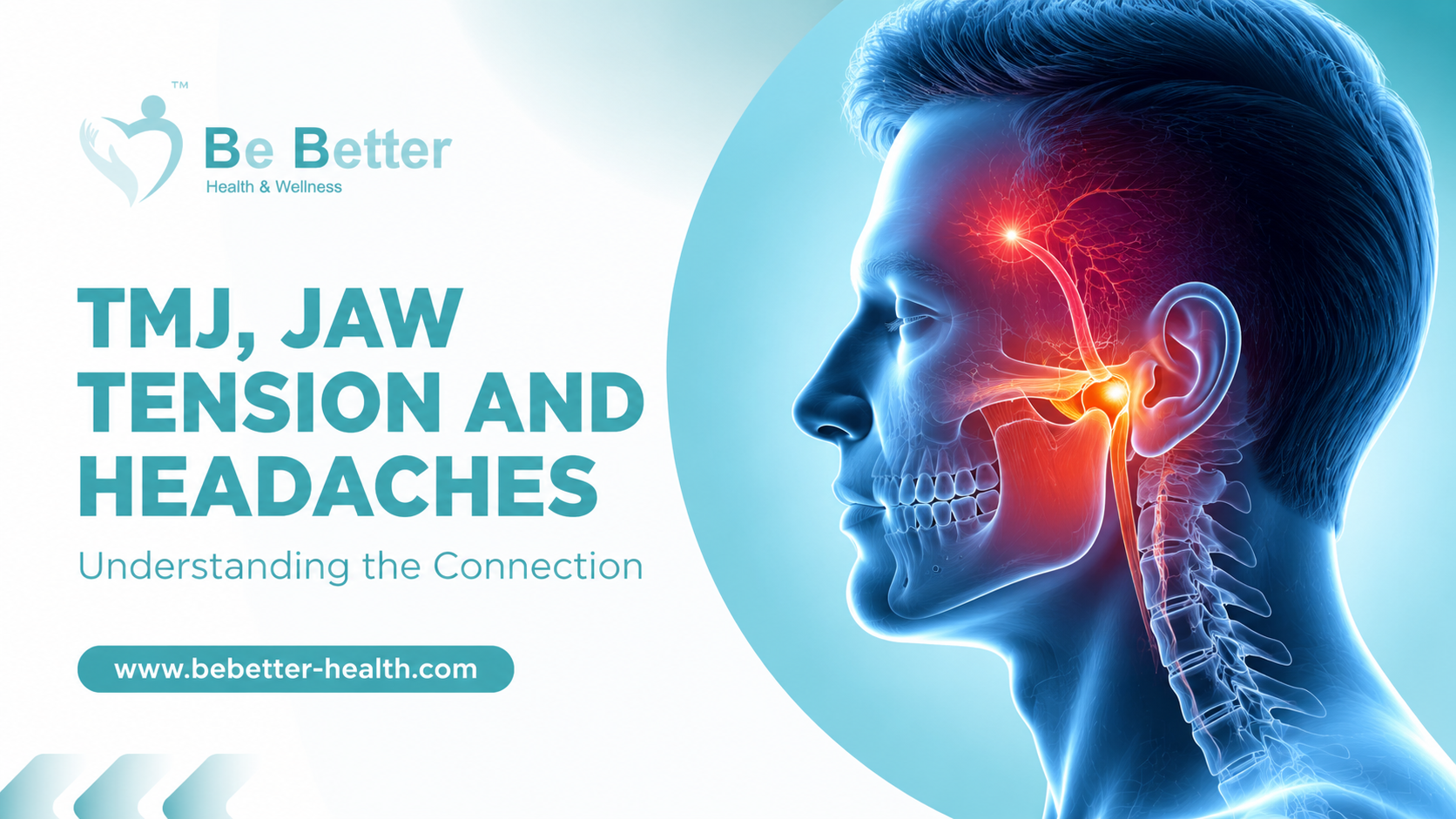
The temporomandibular joint (TMJ) is one of the most complex and frequently used joints in your body. Every time you speak, chew, yawn, or even swallow, this small but mighty joint is at work. When dysfunction occurs in this area—a condition broadly referred to as temporomandibular disorder (TMD)—the ripple effects can extend far beyond the jaw itself.
A TMJ headache is one of the most common yet frequently misdiagnosed consequences of jaw dysfunction. These headaches often masquerade as tension headaches or migraines, leading many people down a frustrating path of treatments that address the symptom but miss the underlying cause.
The mechanism behind TMJ-related headaches involves the intricate network of muscles, nerves, and connective tissues that connect your jaw to your head, neck, and shoulders. When your jaw joint is misaligned, overworked, or under chronic stress, the muscles surrounding it—particularly the temporalis, masseter, and pterygoid muscles—can become tight, fatigued, and trigger-point laden. This muscular tension refers pain directly into the head, creating that familiar headache pattern.
Recognising TMJ Symptoms That Point to Headache Origins
Understanding the full spectrum of TMJ symptoms can help you identify whether your headaches might have a jaw-related component. Common signs include:
Jaw-specific symptoms:
• A clicking jaw or popping sound when opening or closing your mouth
• Jaw pain when chewing, especially with harder or chewy foods
• Difficulty opening your mouth fully or a sensation of the jaw “catching”
• Morning jaw stiffness or soreness
• Tenderness along the jawline or in front of your ears
Head and facial symptoms:
• Headaches that begin near the temples and spread across the forehead
• Pain behind the eyes
• Facial pain or a sense of pressure in the cheeks
• Ear pain, fullness, or ringing (tinnitus) without an ear infection
Associated symptoms:
• Neck and shoulder tension
• Tooth sensitivity without dental cause
• Changes in how your teeth fit together when you bite
If several of these resonate with you, your recurring headaches may indeed be TMJ headaches
warranting a closer look at your jaw function.
Tooth Grinding and Clenching: A Major Contributor
One question I’m frequently asked is whether tooth grinding—known clinically as bruxism—can cause headaches in and of itself, even without other obvious TMJ problems.
The answer is a resounding yes.
Bruxism, whether it occurs during sleep (nocturnal bruxism) or while awake (diurnal bruxism), places enormous strain on the jaw muscles and the temporomandibular joint. The forces generated during grinding and clenching can be several times greater than normal chewing forces. Over time, this repetitive stress leads to muscle fatigue, hypertonicity (excessive muscle tension), and the development of myofascial trigger points.
These trigger points—tender knots within the muscle tissue—are notorious for referring pain to distant areas. Trigger points in the masseter muscle, for instance, commonly refer pain to the eyebrow, upper jaw, and lower jaw, while trigger points in the temporalis muscle refer pain across the temple and into the head, mimicking tension-type headaches.
What makes bruxism particularly problematic is that many people are completely unaware they’re doing it. Sleep bruxism often goes unnoticed unless a partner hears the grinding sounds, or until symptoms become impossible to ignore. Daytime clenching is similarly unconscious for most people—a habitual response to stress, concentration, or even poor posture.
The relationship between bruxism and headaches creates a self-perpetuating cycle: stress leads to clenching, clenching leads to muscle tension and pain, pain increases stress, and the cycle continues.
Breaking this cycle requires both awareness and targeted intervention—something that a structured self-management approach can effectively address.
Why Does My Jaw Hurt? Understanding the Root Causes
When patients come to me asking “why does my jaw hurt?”, I always emphasise that TMD rarely has a single cause. Instead, it typically results from a combination of factors that, together, overwhelm the jaw system’s capacity to adapt.
Common contributing factors include:
Structural factors: Dental misalignment, missing teeth, poorly fitting dental work, or natural variations in jaw anatomy can alter how forces are distributed through the joint.
Muscular factors: Chronic tension in the jaw, neck, and shoulder muscles—often related to stress, posture, or bruxism—places ongoing strain on the TMJ.
Behavioural factors: Habits such as nail-biting, gum chewing, resting your chin on your hand, or holding your phone between your ear and shoulder can contribute to jaw dysfunction over time.
Postural factors: Forward head posture, common in our screen-dominated world, changes the resting position of the jaw and increases tension in the muscles that control it.
Stress and emotional factors: The jaw is exquisitely sensitive to emotional states. Anxiety, suppressed anger, and chronic stress commonly manifest as jaw tension and clenching.
Systemic factors: Inflammation, hormonal changes, sleep disturbances, and nutritional deficiencies can all influence pain sensitivity and muscle function.
This multifactorial nature is precisely why a holistic, integrative approach to TMJ management often succeeds where single-intervention treatments fall short.
Red Flags: When to Seek Further Medical Attention
While many TMJ-related headaches respond beautifully to self-management strategies, it’s essential to recognise when professional medical evaluation is necessary. Certain symptoms warrant prompt attention to rule out other conditions or to access appropriate treatment.
Seek medical attention if you experience:
• Sudden, severe headache that comes on like a “thunderclap”—this could indicate a serious neurological event
• Headache accompanied by fever, stiff neck, confusion, or visual changes—potential signs of infection or other serious conditions
• Progressive worsening of headaches over weeks or months despite self-care measures
• Headaches that wake you from sleep or are significantly worse in the morning
• Neurological symptoms such as weakness, numbness, difficulty speaking, or changes in vision accompanying your headaches
• Jaw locking that prevents you from opening or closing your mouth
• Significant changes in your bite or how your teeth fit together
• Unexplained weight loss or systemic symptoms alongside your jaw pain and headaches
• History of cancer with new onset headaches
• Headache following head trauma, even if the injury seemed minor
Additionally, if your jaw pain is accompanied by chest pain, shortness of breath, or pain radiating down your arm, seek emergency care immediately, as jaw pain can occasionally be a referred symptom of cardiac events.
If you’ve been managing your symptoms on your own for several weeks without improvement, or if your symptoms are significantly impacting your quality of life, work, or sleep, it’s time to consult with a healthcare professional who can assess your condition thoroughly.
The Path Forward: Empowering Yourself with Knowledge and Tools
Here’s what I’ve learned in over four decades of clinical practice: the people who achieve the best outcomes with TMJ/TMD are those who become active participants in their own healing.
Understanding your condition is the first step. Recognising your personal triggers, learning to interrupt harmful patterns, and implementing targeted self-care strategies can profoundly reduce—and in many cases resolve—TMJ symptoms and their associated headaches.
This is precisely why I developed my TMJ Self-Management Course—to put practical, evidence-informed tools directly into your hands. Visit bebetter-health.com to learn more.
In this comprehensive programme, you’ll learn:
• How to identify your unique contributing factors and create a personalised management plan
• Gentle jaw exercises and stretches to restore mobility and reduce muscle tension
• Self-massage and myofascial release techniques to address trigger points at home
• Postural awareness and corrections to reduce strain on your jaw throughout the day
• Stress management and relaxation techniques specifically targeting jaw tension
• Lifestyle modifications including sleep positioning, dietary considerations, and habit awareness
• When and how to seek additional professional support
The course is designed to meet you where you are, whether you’re newly experiencing symptoms or have been struggling with TMJ issues for years. It’s structured so you can work through it at your own pace, revisiting sections as needed.
You Don’t Have to Live with This Pain
If you’re tired of waking up with headaches, wincing through meals because of jaw pain when chewing, or feeling like your jaw has become an unreliable partner in your daily life, please know that improvement is possible.
TMJ dysfunction and its associated headaches are not something you simply have to accept. With the right knowledge, consistent self-care practices, and attention to the interconnected factors that contribute to your symptoms, you can reclaim comfort and function.
I invite you to take the first step toward lasting relief by exploring my TMJ Self-Management Course at bebetter-health.com. Because understanding your body is the foundation of healing it.
Berdene Segal is an Integrative Health Consultant with over 40 years of clinical experience. She holds a BSc in Physiotherapy, an Advanced Master’s Degree in Integrative Medicine, and is a Craniosacral Therapy Practitioner (Upledger Institute®). Through Be Better Health and Wellness, she helps clients address complex health challenges using a holistic Body-Brain-Being approach.
Disclaimer: This document is for educational purposes only and does not constitute medical advice. Always consult with a qualified healthcare provider for diagnosis and treatment of any health condition. If you are experiencing severe symptoms or red flag signs as described above, please seek medical attention promptly.